Best Water Purifier for Home
Best Water Purifier for Home — Why “High-Ticket” Matters (With Focus on TDS & Service Quality)
Choosing the right water purifier for your home in India is more than just about “pure water” — it’s about matching the purifier’s capabilities to the TDS (Total Dissolved Solids) levels of your water source + having reliable service and after-sales support. This becomes especially important if you are buying a “high-ticket” purifier — which means higher upfront cost, but ideally better water quality, durability, and long-term reliability.
Here’s what you should know, why brands like Eureka Forbes (Aquaguard) and Kent remain relevant — and a few premium purifier picks worth considering.
✅ Why TDS & Service Quality Should Guide Your Decision
• What is TDS — and why it matters
- TDS (Total Dissolved Solids) measures the concentration of dissolved salts and minerals (like calcium, magnesium, sodium, bicarbonates, etc.) in water. It’s expressed as mg/L or ppm.
- As per Indian standards and common guidance, water with up to ~500 ppm TDS is generally considered acceptable for drinking; but “ideal” drinking water often lies in lower ranges — many sources suggest 50–200 ppm as optimal.
- If TDS is low (e.g., municipal or treated water), using a high-power RO purifier may remove beneficial minerals, leading to “flat” taste water. In this case, purification methods like UV + UF — which disinfect but retain minerals — are often sufficient.
- If TDS is high (borewell water, tanker water, groundwater, etc.), you need an RO (Reverse Osmosis) purifier — preferably with a TDS controller or mineralizer to balance purity with healthy mineral content.
• Service quality — the often-overlooked factor
- A purifier is not a “buy-and-forget” product. Over time, filters need replacement, membranes degrade, and regular maintenance becomes essential. The real cost often isn’t the purchase price, but the Annual Maintenance Cost (AMC) and ease of accessing service.
- For high-ticket purifiers, good service support becomes critical — otherwise you may end up with non-functional equipment or even re-buy within a few years. Many reviews point out that after-sales service can vary widely depending on your city or locality.
Because of this — if you’re investing in a higher-end purifier — you ideally want robust purification + mineral retention + wide service network + reliable maintenance.
Highlights
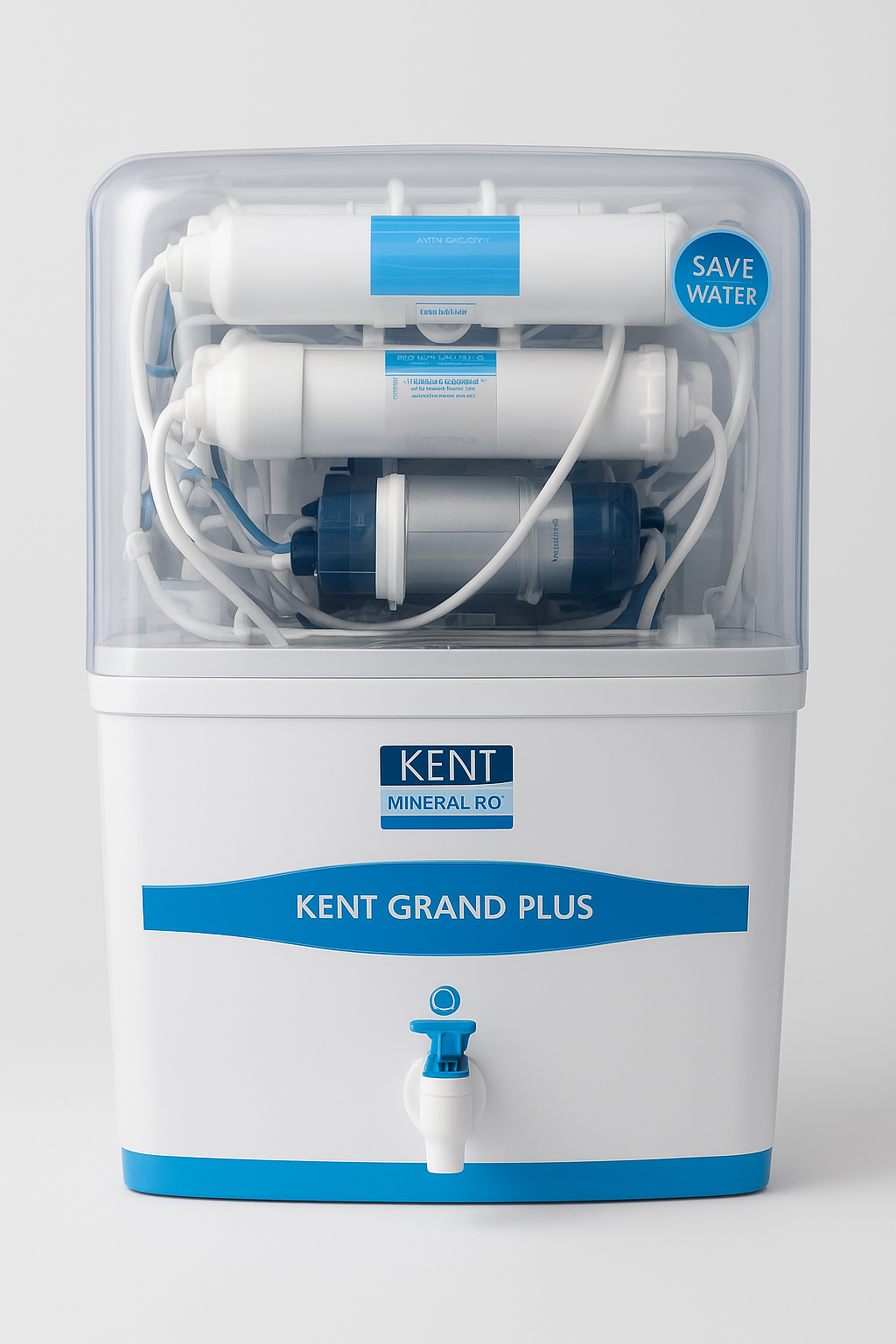
- Kent Grand Plus Water Purifier — A high-end RO + UV + UF purifier with mineral retention and TDS control; ideal if your water has medium-to-high TDS (borewell/tanker water). Good for 4–6 person households.
- Kent Grand RO Water Purifier — Balanced RO + UF combo, suitable for water sources with high TDS. Its TDS controller helps retain essential minerals, addressing the “flat water” issue common with basic RO systems.
- Aquaguard Slim Glass Water Purifier — A premium-looking purifier from Eureka Forbes, suitable for urban homes with variable water quality; offers a good mix of RO + UV + mineralization.
🧠 How to Choose — Step by Step
- Test the TDS of your water (use a small TDS meter).
- If TDS ≤ ~200–300 ppm → UV + UF (or gravity-based) purifier is sufficient.
- If TDS is higher — especially > 500 ppm or variable — go for RO + TDS control / mineralizer.
- Consider usage and family size — smaller tanks for 2–3 members; larger (7–8 L or more) for 4–6+ members.
- Check after-sales service and availability of spares — in cities like Mumbai, having a purifier from a brand with a strong service network is a major plus.
🔎 Final Thoughts
- A “high-ticket” purifier is worth it only if you match it right to your water’s TDS, have long-term service reliability, and need features like mineral retention and multiple filtration stages.
- Don’t blindly buy RO-purifiers; test your water first — sometimes simpler UV/UF systems are enough and more efficient.
- Prioritize service network and maintenance costs when buying heavy-duty purifiers — that often makes or breaks long-term value.